Oropouche is often nicknamed “sloth fever” because the virus naturally lives in sloths (as well as other primates and some bird species).3
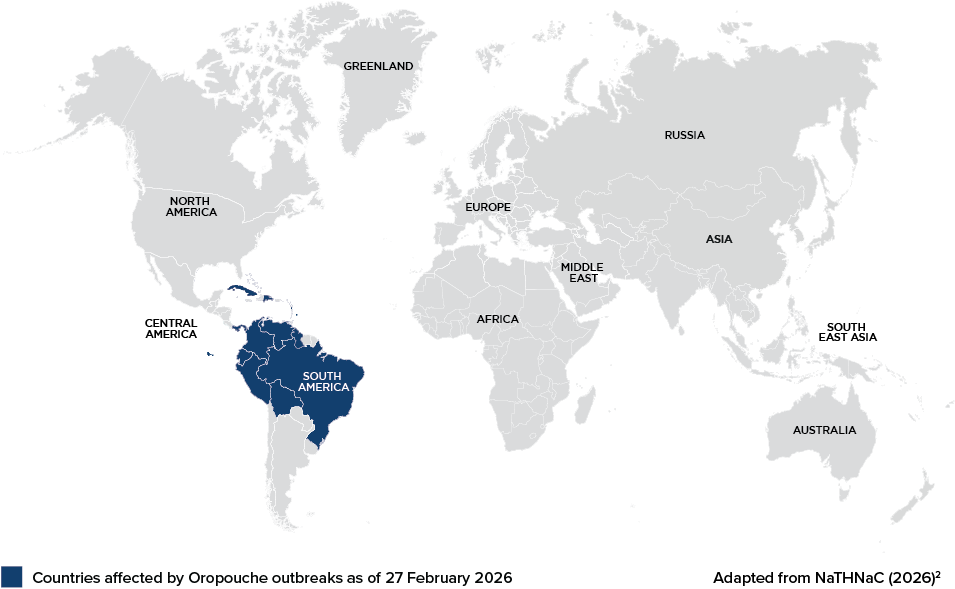
Risk areas for Oropouche
FAQs
-
Key fact
-
How do you get oropouche?
From getting bitten by midges or mosquitoes that are carrying the virus.4 Some studies have also shown that infected mothers may be able to pass oropouche to their babies during pregnancy.5
-
What are the symptoms of oropouche?
The majority of people infected with oropouche will initially experience a sudden onset of symptoms such as fever, headache, joint and muscle pain, chills, nausea, vomiting, and rash.1
Up to 60% of patients will also suffer a second bout of these symptoms a few days or even weeks later.6
-
How serious is oropouche?
While the symptoms are unpleasant, most people make a full recovery from oropouche.1 However, up to 4% of people infected will develop more severe symptoms affecting the brain, which may require hospitalisation.1,7
-
Which countries are affected by oropouche?
Most cases and outbreaks occur in South America and the Caribbean, with Brazil reporting the highest number of cases.7 A small number of travel-associated cases have also been reported in the USA and Europe, including the UK.4
-
Can I prevent getting oropouche?
You can take the following precautions to help reduce your risk of being bitten by an infected midge or mosquito:
- Wear loose-fitting clothing with long sleeves and trouser legs8
- Use a recommended insect repellent containing either Picaridin, DEET, PMD, OLE (oil of lemon eucalyptus), IR3535, or 2-undecanone8
- Be extra cautious around 4–6pm as this is peak biting time for the midges that most commonly carry Oropouche virus.9
Ready to get started? Check now for your nearest travel health clinic.
Get friendly advice from the UK's largest network of travel clinics*.
* This list is not exhaustive and other travel health providers are available.
References
- Centers for Disease Control and Prevention. Clinical Overview of Oropouche Virus Disease. Oropouche. November 2025. Available at: https://www.cdc.gov/oropouche/hcp/clinical-overview/index.html. Accessed: April 2026.
- NaTHNaC Travel Health Pro. Country List – Oropouche Outbreaks. Available at: https://travelhealthpro.org.uk/countries. Accessed: April 2026.
- UK Health Security Agency. What are the symptoms of Oropouche virus disease and how can you avoid it? – UK Health Security Agency. August 2025. Available at: https://ukhsa.blog.gov.uk/2025/08/13/what-are-the-symptoms-of-oropouche-virus-disease-and-how-can-you-avoid-it/. Accessed: April 2026.
- UK Health Security Agency. Oropouche virus disease. January 2026. Available at: https://www.gov.uk/guidance/oropouche-virus-disease. Accessed: April 2026.
- Cola JP, dos Santos APB, Zanotti RL, et al. Maternal and Fetal Implications of Oropouche Fever, Espírito Santo State, Brazil, 2024. Emerg Infect Dis. 2025;31(4):645-651.
- Pan American Health Organization. Oropouche virus disease. Available at: https://www.paho.org/en/topics/oropouche-virus-disease. Accessed: April 2026.
- NaTHNaC Travel Health Pro. Oropouche virus disease: information for travellers and health professionals. August 2025. Available at: https://travelhealthpro.org.uk/news/788/oropouche-virus-disease-information-for-travellers-and-health-professionals. Accessed: April 2026.
- Centers for Disease Control and Prevention. Preventing Mosquito Bites. August 2024. Available at: https://www.cdc.gov/mosquitoes/prevention/index.html. Accessed: April 2026.
- Feitoza LHM, de Carvalho LPC, da Silva LR, et al. Influence of meteorological and seasonal parameters on the activity of Culicoides paraensis (Diptera: Ceratopogonidae), an annoying anthropophilic biting midge and putative vector of Oropouche Virus in Rondônia, Brazilian Amazon. Acta Tropica. 2023;243:106928.
UK-BOTB-2600001 | April 2026